Category Archives: Evangelism

The Dynamic Duo: St. Peter and St. Paul – by Deacon Marty McIndoe

StPeterStPaulImage of St. Peter and St. Paul (available at www.orthodoxgoods.com)

June 29th marks the Catholic Feast of St. Peter and St. Paul.  Since these two men are usually considered the most important Christians of the apostolic age, you would think that they would each have their own Feast day.  However the Church, in its wisdom, has always celebrated these two men together.  We can learn a great deal about living as a Christian, and about Church structure, by looking at these two fascinating men and their relationship to each other.  They both died in Rome and their bodies remain there to this day.

According to Roman legend, Rome was founded by twin brothers, Romulus and Remus.  Their background and early raising was quite tumultuous and their decision to found together a new city proved fatal for Remus.  Ambition and sibling rivalry reared its ugly head, but the city of Rome was founded.  Rome became one of the most powerful cities (and Empire) in the world, but it lost its worldly power about 400 years after Jesus was born.  About 25 years after Jesus died and resurrected, two new brothers (in the Lord) founded a new spiritual city of Rome which to this very day maintains its spiritual power throughout the world.  St. Peter and St. Paul have been considered the new co-founders of this spiritual city of Rome.  Early Christian writers made this comparison many times.  We know St. Peter as being the first Pope and St. Paul as being the greatest evangelist, and scripture writer.  Let us take a look at their relationship.

St. Peter was hand chosen by Jesus to lead the Church.  Peter had known Jesus and followed Jesus for many years.  He was a true disciple of Jesus.  St. Paul, on the other hand, never met Jesus until after Jesus died and rose again.  In actuality, St. Paul was an arch enemy of the early Christians because of his zeal to remove the followers of the Jesus sect from his most loved Judaism.  St. Paul was even there for the first martyrdom of St. Stephen.  St. Peter fervently loved Jesus, and St. Paul fervently loved Judaism.  When St. Paul met the Resurrected Jesus, on his way to Damascus to persecute Christians, St. Paul was literally knocked to the ground.  This one time meeting with the resurrected Jesus was enough to totally change St. Paul from persecutor of the Church to evangelizer for the Church.  The early Christians, including St. Peter, were quite skeptical but came to see the change in St. Paul and his zeal for building the Church.

We don’t know for certain how many times St. Peter and St. Paul met, but scriptures tell us of three incidents.  The first one seems to occur around the year 51 when in Galatians 1:18 Paul tells us that he went to visit St. Peter in Jerusalem for 15 days.  The interesting part of this is that the word that St. Paul uses for the visit is historeō which has a very rich meaning.  It implies meeting to gather data, to learn, observe and inquire.  Our word history comes from that root.  That must have been an interesting meeting.  St. Peter was probably still somewhat skeptical of St. Paul, and St. Paul was probably trying to learn as much as possible about Jesus and His followers.

In Galatians 2:1 St. Paul tells us of another meeting he had with St. Peter 14 years after the first meeting.  St. Paul came to Peter and James and John, the pillars of the Jerusalem Church, to present to them his form of evangelization and to verify the fruits of his evangelization.  He seems to have been checking with them to make sure he was doing it well.  St. Paul records that they found nothing to add to what he had been preaching and that they recognized him as being the evangelizer to the Gentiles.  They gave him their right hand of fellowship and encouraged him to keep preaching to the Gentiles while they preached to the Jews.  He ended by saying, “They only asked us to remember the poor– the very thing I also was eager to do.”

The third time that scriptures (again Galatians) mention the two meeting is at Antioch.  This some people play up as a confrontation between the two.  However, it appears that it is a great example of collegiality, and fraternal correction.  The background for this meeting goes back to the Council of Jerusalem where St. Peter made the judgment that Gentile converts to Christianity did not have to observe the Jewish kosher laws.  Now when St. Peter was in Antioch, he was staying with many Jewish Christians who felt that new Gentile converts should keep the kosher laws.  Peter even followed the kosher laws when he was with them.  St. Paul brought to the attention of St. Peter that he was being hypocritical.  It appears that St. Paul really did this out of love and for fraternal correction and that the bond of love that they each had for Jesus triumphed.  Later scriptures and tradition show that these two men kept their fraternal love for each other.

We know that towards the end of their lives, both St. Peter and St. Paul move to Rome.  All of the early Christian writers talk about them being the new brothers who formed the new Rome.  This time, however, there was no ambition or rivalry to separate them; quite the contrary.  Tertullian, an early Christian writer born in 155 tells how both St. Peter and St. Paul were imprisoned together during Nero’s persecution and both were martyred by Nero.  He recalls that they spent many hours together in jail sharing their stories of spreading the Gospel and he added that they blessed each other for their upcoming martyrdom.  St. Peter was crucified upside down (he said he was not good enough to die the same way as Jesus) in the Vatican square and immediately buried in a nearby cemetery, now below St. Peter’s in Rome.  St. Paul was beheaded with a sword.  He was a Roman citizen and due a quick death.   He was beheaded at quae Salviae, which is now known as Tre Fontane (three fountains).  According to legend, when the sword cut off St. Paul’s head, it bounced three times and at each spot where it landed, a spring of water sprung forth from the ground.  His body was taken away and buried nearby.  The beautiful Church of St. Paul’s Outside the Walls stands over his burial place.  It is interesting to note that the Tiber River flows through Rome.  St. Peter was martyred and was buried on one side of the Tiber, and St. Paul was martyred and buried on the other side.  Early Christian writers see this as both “founders” having given their blood to bless both sides of the city.  Though these two dynamic men were individuals, they were seen as a major force of  a unified two.

St. Peter was a simple Jewish fisherman with probably little education.  St. Paul was well educated (taught by the best rabbi in the land) and a Roman citizen.  They both were good Jews.  St. Peter was married and St. Paul was a celibate.  St. Peter was impulsive and St. Paul was enthusiastic.  They certainly had their differences.  They both have in common that when they met Jesus their lives were totally changed.  They both loved Jesus and His Church.  Even though both were quite dynamic men with great leadership skills, they learned how to work with each other for the good of the Church.

For us today, we should see that when we truly love Jesus, we change for the good.  When we truly love the Church that Jesus founded, we learn to work together with each other, even when we don’t always agree with each other.  It is almost incomprehensible to understand how these two men accomplished so much in such a short time.  The only way we can understand that is to see them as lovers of Jesus, filled with the Holy Spirit, who respond to “go forth” and spread the good news and build up the body of Christ.  I can only imagine the great time the two of them are having with Jesus right now.  I look forward to meeting them some day.  St. Peter and St. Paul pray that we too can love Jesus with all that we are.


Trinity Missions – a Look at Serving God through Serving the Poor by Deacon Marty McIndoe

20160209_133340Behind altar is a stained glass that has both Indian and Christian symbols

20160209_133746St. Kateri Tekawatha, for whom the main Parish is named

20160209_142445Martha and me and Fr. Dono, ST, in front of one of the mission altars.  They really love the Saints and dress them up very colorfully.

20160209_142554Native made crucifix

We, as Catholics, should be very proud because our Church feeds, clothes, heals, educates and cares for more people than any other organization on the face of the earth.  We do this because this is what Jesus asks us to do.  The Church has many different charities that do this.  On this Trinity Sunday, I would like to share with you about one charity that I have supported for over thirty years.  They are Trinity Missions, also known as Missionary Servants of the Most Holy Trinity.  They describe themselves; As apostles – our missionaries preach and live the word of God to bring hope, comfort, and relief to the suffering of the poor, the abandoned, and the most neglected by:

  • Spreading the Gospel;
  • Responding to the needs of the poor, isolated, marginalized, and those without hope; and
  • Guiding, forming, and ministering with lay missionaries in parishes, neighborhoods, and communities across the United States and Latin America.

I have firsthand knowledge that they really do this quite well, with very limited resources.  Over thirty years ago, I read about the work that they do with Native Americans on reservations throughout the United States.  Since I have some Native American blood in me, I became quite interested.  We started donating to them and each month kept looking forward to the letters that we received from some of the Priest Missionaries that were on the reservations.  These letters described all the work that they did, and all the work that they really hoped to get done.  There was no doubt that they had a formidable task, but they learned to do as much as they could with what they had.  Personally, I think that they do very well in serving the Lord in His poor.

In the early 80’s, I attended several Priests and Deacons Conferences at the Franciscan University in Steubenville Ohio.  At one of these conferences, I was in a small discussion group with other priests, deacons, and bishops.  We all introduced ourselves and where we were from.  After the introductions, one of the Missionary Priests from Trinity Missions asked me if I were the Deacon Marty from Patchogue, New York.  I told him that I was, and he told me that he had heard about what a great preacher I was.  Now I was ordained only a few years them and I wondered how a missionary priest living on an Indian reservation out West could possibly have heard about me.  It turns out that his parents lived in my parish and liked my sermons and had told him about me.  This began a very good friendship with him.  This last winter, my wife and I visited with him on his missionary post at St. Kateri Tekakwitha Parish in South Tucson, Arizona.  He and another priest and one brother serve seven local Indian reservation Parishes.  All, but one, of the reservations are quite poor.  The other is starting to come out of poverty due to a local Casino that they had opened up.  It seems that the Lord can draw good out of gambling.  We spent five days touring all seven reservations and spent time with the peoples and attended different liturgies there.  It was a beautiful, loving, learning, faith filled experience.  I was very impressed by the faith that these Native Americans had, thanks to the work of many missionaries.

We must not forget the mission that God gave to us; namely, to spread the Gospel and to care for His people.  The Church does a wonderful job of this, but needs the help of all of its members.  We have to personally do this in our own lives with the people that are around us.  However, we cannot forget that the Church reaches out to all peoples and needs us to join in on its global missionary call by our financial support and by our prayers.  On this Trinity Sunday, where we celebrate the Three in One, bound together by perfect love, let us remember that we are all one and called to be bound together in love.  We certainly can do this by supporting our Church missions and charities through prayer and financial assistance.  God bless.

Check out Trinity Missions at: http://www.trinitymissions.org


Goodness – Language of Evangelization by Patrick Sullivan

Israel 185Church of the Beatitudes on the Sea of Galilee in the Holy Lands

What is goodness if not the human struggle to be like God? Not in some demonic usurpation or mutiny among men bent on overthrowing our most loving and benevolent Creator, but to actually try with all that we have to be perfect, as our heavenly Father is perfect. To speak the way Jesus has spoken. To love who Jesus loves. To recognize Jesus in our day to day in order to be recognized by our Lord as we pass from this world to the next.

You know, before the new and everlasting covenant in Jesus Christ, it was the Torah (the Law) given to Moses that lifted humanity out of the mire and the inconsistencies of the pagan world; but today the law will no longer do.

To quote the law to someone with the aim of bringing them to God, whether the Mosaic or canonical, or even what the philosophers have called the natural law, seems to shut down rather than open up a dialogue on what we were all meant to be. We have to understand that to many, trying to teach goodness through the law is like teaching them that music is only as profound as the notes on the page; never to be played. To try to teach the ethic and not the ethos, it is like we have been trying to convince the world of a brilliant theatrical performance by showing them the program with its lovely cast of performers.

No, no, goodness is caught when it is found in a person and not a checklist. When it reveals rather than reflects.

What I mean is, if you are trying to evangelize a person, and all they can see is someone who is just as good as they are; just as generous; just as patient; just as forgiving; if it seems like you  have checked off the same boxes as they have; you will not win them over in the least.

But if they look at you and rather than reflect their own level of moral achievements; you reveal a greater generosity; a greater patience; a greater willingness to forgive; in short if you show them real, concrete examples of one striving to be like God, what happens?

It poses a question. And while the question in their minds may take many forms, essentially what they want to know is this: why are you so good?

So, If you are evangelizing someone and their language is goodness, your job is a straightforward one. Stop quoting the law, and begin surpassing the day to day sacrifices and social programs of the unbeliever. Our God can do better, it’s time to show them.

Patrick Sullivan is a Catholic Lay Evangelist, author and speaker.  He has written two books, Dare to Be an Evangelist and Four Monks Walk in to a Pub and has many you-tube videos.  Check out his website at http://evango.net

A Very Special Gift by Deacon Marty McIndoe

Israel 632Looking up to the Upper Room (Cenacle) in Jerusalem

As we approach Pentecost this weekend, it is important for us to see what a precious gift God has given us in the Holy Spirit.  This feast dates back to the first century and finds its beginning in the descent of the Holy Spirit on the Disciples nine days after the Ascension of Jesus.  In all actuality, Scripture shows us that this Spirit has been promised to us by God since the earliest times.  The Old Testament is filled with references to the Holy Spirit beginning with the second verse of Genesis where it is said that the Spirit of God was moving over the face of the waters.  When the Church blesses the water to be used for Baptism it says, “At the very dawn of creation your Spirit breathed upon the waters, making them the wellspring of all holiness”.  The prophets are continually making reference to the Spirit.  The prophet Joel tells us that God will POUR out His Spirit upon us.  The prophet Ezekiel says, “I will put My Spirit within you and you will come to life”.  There are too many references to the Holy Spirit within the Old Testament to cover in this short article.

The prophet, John the Baptist, when seeing Jesus tells us that He will BAPTIZE us in the Holy Spirit.  Jesus himself promises us the gift of the Holy Spirit.  He tells His disciples, “And behold, I am sending forth the promise of My Father upon you; but you are to stay in the city until you are clothed with power from on high.”  Right before His Ascension Jesus tell His disciples, “But I tell you the truth, it is to your advantage that I go away; for if I do not go away, the Helper (Paraclete, Advocate or Holy Spirit) will not come to you; but if I go, I will send Him to you.”  There are so many New Testament references about the promise of the Gift of the Holy Spirit that we could not list them all here.

After the Ascension of Jesus, His Disciples, and His mother Mary all gathered in the Upper Room (Cenacle) to pray.  They were saddened by His leaving and seemed lost as to what to do next.  I think that it is so important to remember that the Blessed Virgin Mary was there praying with the Disciples.  She is the Chosen Spouse of the Holy Spirit and her prayers are so very powerful.  As I grow in my own faith and openness to the Holy Spirit, I grow in my love and adoration of Mary.  The Disciples were so blessed to have her join them in prayer.  We too are so blessed to have Mary join us in prayer.

At his Ascension Jesus told His Disciples to go out to every nation and spread the Good News.  The Disciples were totally unable to do this command and just sat in the Upper Room and prayed.  They prayed for the promised gift of the Holy Spirit for nine days (this is the source of our own nine day novenas) and on the feast of Pentecost it came to them.  Luke, in Acts Chapter 2 tells us, “When the time for Pentecost was fulfilled, they were all in one place together.  And suddenly there came from the sky a noise like a strong driving wind, and it filled the entire house in which they were.  Then there appeared to them tongues as of fire, which parted and came to rest on each one of them.  And they were all filled with the Holy Spirit and began to speak in different tongues, as the Spirit enabled them to proclaim.”  This Holy Spirit empowered them to be able to do the command of Jesus and to go out to the entire world to proclaim the Good News.  You only have to look at the Disciples demeanor before and after Pentecost to see how this Holy Spirit can really EMPOWER us. The Church considers Pentecost its birthday, because the Disciples were now empowered to form the Church.

So what does all this mean to us today?  We are given that very same Spirit that the Disciples were given and it should EMPOWER us too.  We are given the Spirit in Baptism and are called to see it released more within us at Confirmation.  The truth is that many people do not know the POWER that is within them.  Do you?  St. Paul tells us that Spirit that is within us is the same Spirit that raised Jesus from the dead.  Now that is a powerful Spirit.  So why do we not always see this?  I believe that quite simply it is because we don’t know about it that much and don’t ask to be baptized, or fully immersed, in the Holy Spirit.  It is like someone gives you one million dollars and puts it in your savings account.  Unless you know that it is there, and ask to use it, it just sits there.  We need to learn that not only is the Holy Spirit within us, but we need to learn how to use it.  A good study of the Scriptures and Lives of the Saints can help us with that.  Even better is just learning to call upon the Holy Spirit.  When is the last time you did that, and when is the last time you prayed to the Holy Spirit?  Also, ask your mother Mary, the Spouse of the Holy Spirit to join you in prayer for the Holy Spirit just as she joined the Disciples at Pentecost.  Another great source to opening up to this Spirit is by attending a Life in the Spirit Seminar.  Many parishes offer this, especially through their Charismatic Prayer meeting.  Seek one out; it will change your life.  I know that it changed mine.


Come Holy Spirit, fill the hearts of your faithful and kindle in them the fire of your love. Send forth your Spirit and they shall be created. And You shall renew the face of the earth.


Miracles from Heaven by Deacon Marty McIndoe

3000

“There are only two ways to live your life. One is as though nothing is a miracle. The other is as though everything is a miracle.”   Albert Einstein


My wife and I just saw the movie, “Miracles from Heaven” starring Jennifer Garner, Kylie Rogers, Martin Henderson and Queen Latifah.  It was certainly a movie that I would recommend to anyone.  It is based on a true story about an initially happy Christian family living in Texas.  When the movie opens, everything seems as it should be.  There is good family communication, a beautiful farm that they live on, and every Sunday they attend an active Evangelical Church with good music and worship.  The father even says to the mother, “this is the good life”.  Then, the ten year old daughter, Anna, becomes ill.  She has a rare, incurable, digestive disorder where her body cannot handle food.  This disorder causes her severe pain, and there doesn’t seem any hope from the medical world.

The girl’s mother, played extremely well by Jennifer Garner, will do anything to help her daughter.  She struggles with doctors until she finally forces herself upon a specialist in this field at Boston Children’s Hospital.  Even this specialist doesn’t give her much hope.  The mother never gives up on her daughter, but does give up on her faith in God.  The family exhausts all of their financial resources trying to bring comfort to their daughter.  The scenes where she is suffering so badly, while the family cannot do anything to help her, are quite intense and you certainly feel the mother’s anguish.

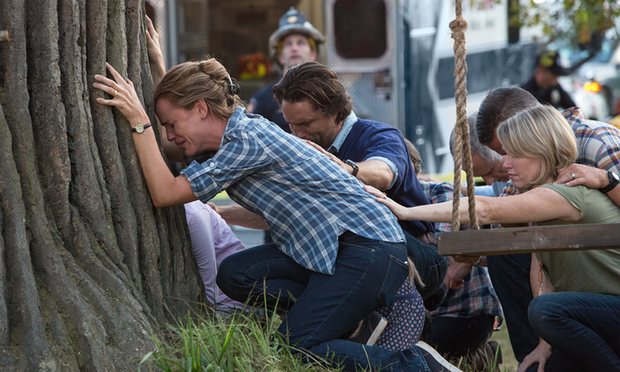
Then, something happens.  The daughter is climbing a tall dead tree in their yard in Texas.  A branch breaks and Anna plummets thirty feet in to the hollow tree.  It takes rescuers many hours to get her out.  When they do, she is brought unconscious to the hospital.  When Anna awakens, the symptoms of the incurable disease are gone.  Anna shares with her mom how God spoke to her in heaven about how he was healing her.  I don’t want to get in to too much detail because I don’t want to spoil the story for you, but her healing is seen as a real miracle by all involved, including the doctors.  This miracle brings back the faith of her mom as well as the faith of many involved.

At the very end, the mother speaks to their church and says some things that are very important.  She recognizes the miraculous healing of her daughter, but also shows how she saw miracles happen throughout the whole journey involving many different people in what would be seen as doing ordinary things.  There is a lot of power there, especially when they flash back on these things.  After the movie ends, they have pictures and videos of the real family.  Make sure you stay for those.

As Catholics, we believe strongly in miracles.  Our history is full of them.  We also know that miracles don’t always happen in the way we want them.  To me, the strength of this movie is not just the actual miraculous healing, but in the family and friends and what they did during the difficult times.  God works miracles in so many ways.  More often than not, he works them through every day, ordinary actions of love.  I would really suggest you take the time to see this movie.  It is so much better than so many movies we are exposed to.  The faith, love, and gift of family and friendship that this movie offers is so refreshing.  God bless.

Light the Fire by Patrick Sullivan

FB_IMG_1459080671146The picture is from lighting the Easter Vigil Fire at St. Francis de Sales in Patchogue, NY


Well it is Monday…and it is cold in my house.


I assumed that with the winter almost over I would not need to maintain the wood furnace so much but waking up this morning it is now obvious that I was wrong.

So here I am sitting by the fire hopeful as I look at the coals and yet consistently disappointed that any flame that seems to appear is blown out the moment I turn my eye from it.

I have stuff to get the fire started, and I have been relying on it heavily, but now I am awake to the possibility that it might not be the right kind of kindle at all.

And the thought has struck me…

Isn’t this precisely what has been happening in the world of evangelization?

There are some who really do think that we are beyond the need to evangelize; that it had its place in something like the winter of the Church perhaps, but since Vatican II it has come and gone, and it is time to move on.

There are others who are constantly amazed that the fire is not ablaze already.

After all, they had already tended to that need; answered that person’s question; provided the parish program that would really knock them off their feet.

And some of us have learned the hard way that every soul is like a single coal just waiting for the right kindle.

Knowing that when you first see the flame that it was called to be, you cannot take your eyes from it assuming that it will break forth into some self sustaining heat.

No, you must constantly feed it, encouraging where you can; providing it with all the oxygen of God that you can convey.

So today, while you tend to the soul our God has called you to, remember that soul will ‘light’ if you find the right fuel; and it will burst into flame over time IF you don’t forget about it.

Have a great day, friends.

in Christ,

Patrick


Patrick Sullivan is a lay Catholic Evangelist, Author and Speaker.

So far, this has meant YouTube videos on various topics from a Christian perspective, speaking at many parish, conference, school and other events, as well as the completion of two books.

The first book was written to meet the needs and challenges of teachers and their students who want to clearly distinguish the Christian Faith from any other (Four Monks Walk into a Pub). And the second book was written to assist all of the faithful Christians out there who want a real plan of action for how to evangelize (Dare to Be an Evangelist).

check out his web page at: http://www.evango.net


An Easter Welcome to Parking Lot and Pew by John and Therese Boucher

Any special plans for Easter: maybe a meal with family or friends, or an Easter egg hunt, or a trip to church in a new spring outfit? Lots of people like to check in with God for this holy celebration of the Resurrection of Jesus, because it underlines the hope of resurrection for earth and soul as well. Whether you consider yourself to be an occasional visitor to your local church or regular churchgoer, here are some easy ways to participate in an Easter welcome.

First of all, keep in mind that God has invited each of us to this year’s celebration. Jesus might call some from the midst of whatever spiritual climate change we are experiencing. The Holy Spirit might beckon through a small, steady voice behind too many drastic spiritual highs and lows. God might speak with a comforting voice, during the inner torrential rains that follows a death, a serious illness or a grave personal loss. God’s stillness might punctuate someone’s search for meaning when there no apparent answers. God speaks and invites. “O, Lord, you have searched me and known me. You know when I sit and when I rise up.” Psalm 139

Secondly, we are all meant to provide a spiritual home for one another, especially when we gather together as the Body of Christ. We are meant to be like the apostles in the same boat together with Jesus. So we ask you, “What will you do to make others feel at home?” Here are some suggestions.

  1. Think about inviting someone to come with you this year and offer a ride.
  2. Arrive early so you can greet others in the parking lot or on the steps of the church.
  3. Move over in the pew before others enter the church. Smile when someone sits beside you.
  4. If you know lots of the songs, sit near the back so that you can encourage others to sing by worshiping with full voice yourself.
  5. Compliment someone or how nice they look or how beautiful their children are.
  6. Introduce yourself to someone you don’t know. Ask what brought him or her here today.
  7. Thank someone for coming. You might add, “I will look for you the next time I come.”
  8. Pray that God will touch someone who has come after a long absence. You don’t have to know who, since God can pour out blessings in many, many ways.

Consider reading our book, Sharing the Faith That You Love, so you can learn more ways to welcome people every week.

John and Therese Boucher are noted authors and run the websites, Catholic Evangelizer, Christ Key and Christmas Carol Festival as well as their own site John and Theresa Boucher.  They also have numerous speaking engagements and run various workshops.    The links are below:

http://www.catholicevangelizer.com

http://www.christkey.com

http://www.christmascarolfestival.com

http://www.johnandthereseboucher.com


7 Steps to Bring Any Young Person Back to the Church by Brandon Vogt

Over the last several years, I’ve spoken with thousands of Catholics around the country at large conferences, small parish groups and everything in between. After each talk I give, there’s usually a time for questions and answers, and inevitably, no matter the topic of my talk, the most common question I hear is some version of “My child has left the Faith, and I’m devastated. What should I do?”

The Catholic Church is hemorrhaging young people.

A recent Pew Research Center study found that half of young Americans (50 percent exactly) who were raised Catholic no longer identify as Catholic today. Think about what that means: Over the last 20-30 years, half of the babies you’ve seen baptized, half of the children you’ve seen confirmed and half of the young people you’ve seen married have probably left the Church.

The Pew study also found that four out of five Catholics who left the Church did so before age 23. These aren’t disgruntled middle-aged adults, fed up with the changes of Vatican II. These are our own sons and daughters, and they’re leaving the Church in high school, college or as young adults.

Most of us know this from experience. We know parents in our parish who grieve their fallen-away children. Maybe our own sons or daughters have drifted away.

Whenever I talk to parents facing this problem, they often use the words “helpless” and “hopeless.” They feel helpless because their children tune them out or ignore them whenever they bring up religious topics, and they feel hopeless because they think it’s impossible their children would ever come back. These parents are desperate to do something — they just don’t know what to do.

I’m convinced what they most need is a plan, for as the French writer Antoine de Saint-Exupéry said, “A goal without a plan is just a wish.” It’s not enough to just sit back and hope our children will return. We need a proven road map.

That’s why I spent several months researching the problem, talking with experts and those who have left and returned, all to determine what really works to draw young people back. The result was a 16-part video course and book that pulls together the best tips, tools and strategies, titled RETURN: How to Draw Your Child Back to the Church.

FREE BOOK! For a limited time, you can claim a FREE copy of the paperback edition of RETURN (you just cover the $4.99 shipping + handling). Click here to get your copy!

But here are seven simple strategies you can use right now to draw your child back. This isn’t a “convert your child quick” scheme, because these steps can take months or years to complete. But they are proven signposts on the road back to faith.

1. Pray, fast and sacrifice

If you aren’t doing these three things, the other steps won’t matter. Commit right now to praying 5-10 minutes each day for your child’s return. Jesus’ parable of the persistent widow (Lk 18:1-8) confirms that God loves tireless prayer — even if you pray for the same need every day. Don’t give up, and don’t think your prayer is unheeded or pointless. Look at what St. Monica’s prayers did for St. Augustine.

Also, fast and sacrifice for your child. Skip a meal, give up Facebook or Netflix for a week or willingly bear a small pain. Then offer your sufferings to God on behalf of your child. Unite them to the cross and ask that he send new grace into your child’s life.

2. Equip yourself

You can’t give what you don’t have. You may be excited about sharing the Faith, but enthusiasm and goodwill won’t get you far. You need to know your faith. The two go-to sources are the Bible and the catechism. Become familiar with them and read them each day, in small doses.

Then find good Catholic books that will help you explain and defend the Faith so you’re ready when your child reveals his main hang-ups with the Church.

3. Plant the seeds

You should also begin planting “seed gifts” in his life. These are DVDs, books or CDs that can lead him to reconsider the Church. Many people who come back to the Church point to a resource like this that sparked their return. Leave a booklet on his desk, mail him a DVD or drop a CD in his car.Even before you start discussing God or the Church with your child, you need to plant small seeds of faith and trust in his life. One seed is unconditional love. Your child needs to know that you’ll love him no matter what — no matter his moral choices or whether he stays away from the Church. He must know that you totally will his good. Only then will he listen to you.

BONUS: Want the 12 best seed gifts? The 12 best books, DVDs, and CDs to give a fallen-away young person? I’ve pulled them all together for you in the RETURN Complete Game Plan.

4. Start the conversation

At some point, you need to open a dialogue about God and the Church. You might say, “Can I ask you something? I wonder if you’d be up for talking about spiritual things some time. I know you have a mixed relationship with the Church, but would you be open to chatting about it with me? I just want to listen.”

Then do just that: listen. Your goal is to detect why your child has drifted from the Church. Note that the reasons he gives may be different than what you expect. Ask him what he believes and why, and what pushed or pulled him away.

Don’t respond to the objections or criticisms just yet — just absorb them. This may involve biting your tongue, but the scar tissue will be worth it!

5. Move the dialogue forward

RETURN-Sidebar1You’ve now identified why your child left the Church. Maybe he drifted away unintentionally. Maybe he switched religions. Maybe he disagrees with the Church’s moral teachings. Or maybe he no longer believes in God. Whatever the case, now’s the time to start discussing those factors.

Speaking with joy and positivity, clear up any misconceptions he has. For example, if he says, “I was never spiritually fed as a Catholic,” it’s likely he never fully understood the Eucharist or was exposed to the great spiritual masters of our tradition. Gently propose those to him and encourage him to reconsider.

6. Invite and connect

Once your child expresses curiosity and openness to returning, invite him to a parish event. This might be a weekend retreat, such as Christ Renews His Parish or Cursillo, or perhaps a parish small-group study or community event. Your goal is to usher him into the life of the parish, which will re-establish the communal bonds of faith.

If your child is in college, connect him with the local Catholic campus ministry, such as FOCUS or the Newman Center. Leaders there will be thrilled to talk with him and help him on his journey.

Don’t move too fast, though. Only extend these invitations after he’s expressed openness to returning, otherwise you may push him away.

7. Close the loop

Finally, you need to help your child formally reconcile with the Church. Lots of people get stuck here. A priest once told me about a lady who left the Church as a teenager and stayed away for over 30 years. Her reason? She simply didn’t know how to come back.

Don’t let that happen. Once your child is ready to return, talk with your pastor and determine the right steps to close the loop. Maybe he just needs a good confession, or perhaps the Rite of Christian Initiation of Adults (RCIA) is more appropriate. A good priest will assess the situation and determine the best next steps.

Obviously, we’ve only scratched the surface of this road map. To go much deeper, check out the tips and strategies in the RETURN Video Course and book.

The key is to never give up hope. Hopelessness is not a word in God’s vocabulary. As long as your child still has breath, there is always hope. God loves your child even more than you do. As much as you yearn for your child to come home, God desires his return infinitely more and is continually working to make that happen, even when things appear dire.

So trust God, beg him to keep moving in your child’s life, and be confident that he will bring your child home.